
Projected and Actual Harlan County Release Dates
A projected date starts with the court-imposed sentence and credit for prior custody. Kentucky DOC applies the authorized calculation rules for state prisoners, including eligible credits, restrictions, forfeitures and restorations, and concurrent or consecutive sentences. A later parole action, detainer, new judgment, disciplinary credit loss, or recalculation can change the path.
A pretrial detainee does not have a sentence-based projected release date. A bond order may authorize release, but processing, a warrant, another hold, or a receiving agency can prevent immediate departure. The court order and physical jail transaction therefore should not be reported as if they were the same timestamp.
How to Find a Harlan County Release Date
- Identify present custody. Check the Harlan County Detention Center's current-inmate path for continuing local custody, but do not use roster absence as proof of release.
- For a Kentucky state sentence, search Kentucky Online Offender Lookup by name or DOC identifier. Read status, sentence details, location, parole eligibility, and release or supervision fields together.
- Open the Harlan court case or contact the Circuit Court Clerk with a name and case number. Obtain the judgment and later orders that control the sentence.
- If a state felon is housed in the county jail, ask the jailer for the local custody history and compare it with DOC's calculation.
- For a precise completed event, request the booking/release sheet or DOC release record. Ask for date and time, release type, releasing authority, and receiving agency if those fields are maintained and nonexempt.
- Register on Kentucky VINE for a pending status alert, then confirm any notice with the custodian.
Custody system determines the tool. BOP supplies dates for federal sentenced prisoners. ICE ODLS covers immigration detention and recent ICE release within its stated window. No public one-person USMS locator was verified, so use the holding facility, federal docket, or USMS records process.
How Kentucky Calculates a State Release Date
KRS 197.045 governs credits for state prisoners. Its framework includes statutory good time and authorized educational, program, meritorious, or other credits under detailed eligibility rules. Credit is not promised by simply subtracting a standard number from a sentence. Offense category, conduct, program eligibility, forfeiture or restoration, overlapping sentences, and DOC's official calculation control.
State felons can serve time in county jails. 501 KAR 2:060 addresses sentence calculation for that population and connects jail credits to KRS 197.045. Harlan County Detention Center can therefore appear as a releasing institution in Kentucky DOC Daily Releases for a state offender. That does not make the state archive a list of every Harlan bond-out or local sentence completion.
The matching manifest capture below leads to the official Kentucky sentence-credit chapter. Review KRS Chapter 197 through the Kentucky Legislature before interpreting the screenshot.
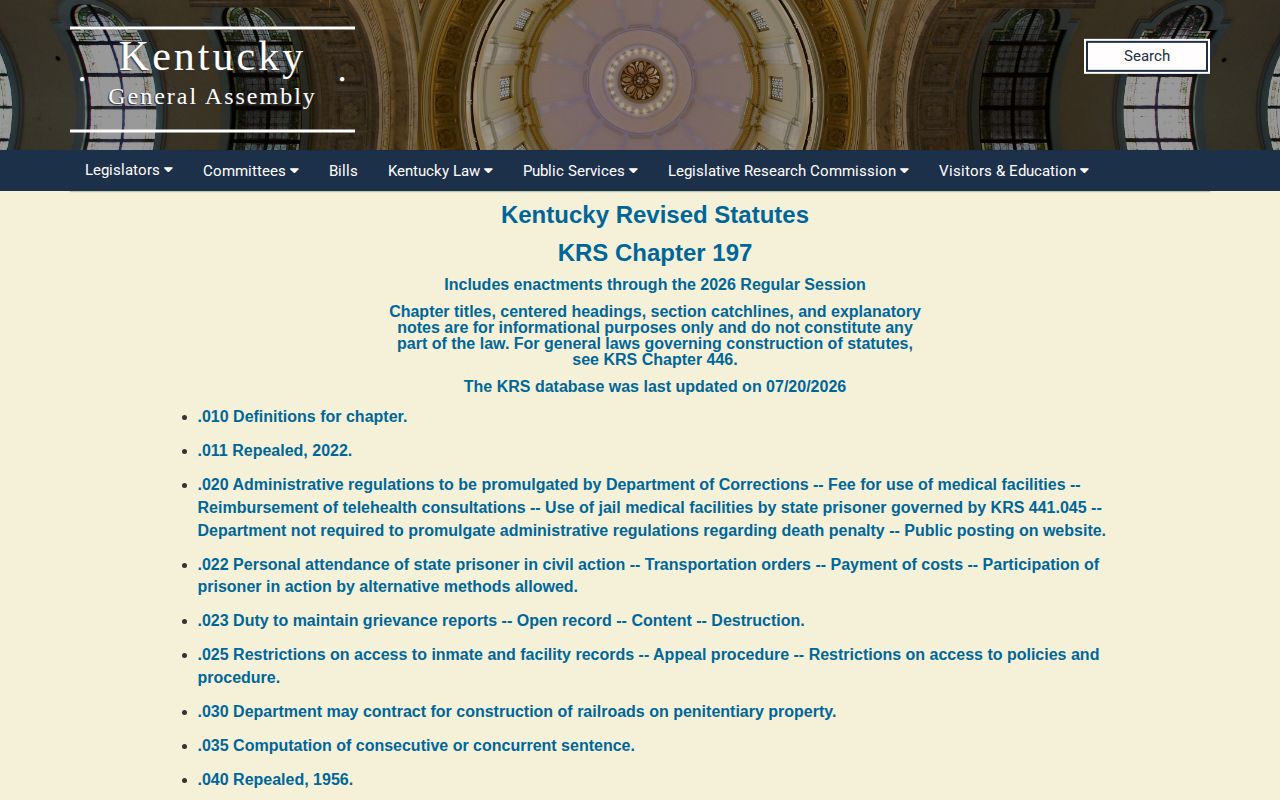
The current statutory text is the authority. A calculation still requires the person's judgment, offense date, custody credit, eligibility facts, and DOC record.
The Kentucky 85 Percent Rule Is Not Universal
KRS 439.3401 creates special minimum-service requirements for defined violent offenders. The widely searched “85 percent rule” does not apply to every Kentucky prisoner. The current violent-offender category, offense result, offense date, sentence type, and statutory exceptions must be checked. For covered cases involving death or serious physical injury, the statute generally restricts parole or specified early release until the required portion is served, with separate treatment for capital and life categories.
Do not apply a generic calculator to all convictions. Parole eligibility under KRS 439.340 and 501 KAR 1:030 is an earliest Board consideration point, not the date a person will leave. A grant can still be followed by placement approval, conditions, detainer resolution, sentence review, and processing.
The successful release-date capture links to the official violent-offender statute. Read the current KRS 439.3401 text for the controlling categories.
The statute image is a navigation and context aid, not a substitute for applying current law to the exact judgment and offense date.
Why a Harlan County Release Date Changes
| Factor | Possible effect |
|---|---|
| Prior custody credit | Changes the credited time used in the sentence calculation |
| Authorized good, program, or meritorious credit | May alter the projected endpoint when statutory requirements are met |
| Disciplinary forfeiture or restoration | Can move a previously displayed projection |
| Concurrent or consecutive sentences | Changes how multiple terms combine |
| New judgment or corrected order | Requires recalculation under the controlling court record |
| Detainer, warrant, or another agency hold | Can prevent community departure even when one sentence reaches a release point |
| Parole decision | A grant, denial, deferment, rescission, or serve-out alters the pathway but is not itself physical release |
| Transfer | Ends one custodian's possession while custody continues with another |
When two official dates differ, identify what each one represents before assuming error. An eligibility date, Board decision date, projected release, maximum expiration, court-order date, docket-entry date, and physical release can all be valid but describe separate events.
County Jail Dates Depend on the Legal Path
No verified Harlan County jail good-time or weekend-adjustment policy was suitable for calculating a local release date. Do not borrow a formula from another county. For a local sentence, ask the jailer or records custodian for the existing calculation or custody-history record and compare it with the judgment. For a state felon held in the county jail, Kentucky DOC's rules and records add another layer.
A person awaiting trial can leave after a qualifying bond order, dismissal, acquittal, or other court action, but another hold can intervene. A sentenced person can reach time served, transfer to DOC, enter supervision, or complete another documented pathway. The same visible roster change can result from any of these events. That is why a named release or transfer code is more useful than estimating from the booking date.
Kentucky DOC Daily Releases is a dated statewide source for state events. It can show a DOC number, release type, releasing institution, sentence class, and supervision district. Preserve labels such as mandatory reentry supervision or administrative minimum expiration rather than simplifying them into parole. The archive does not capture every local Harlan release.
Parole Board Dates Versus Harlan Release Records
The Kentucky Parole Board's schedule proves that a proceeding was scheduled. A published decision proves the Board action. Neither alone proves that the person walked out that day. Search current hearing and decision documents from the Board's official landing page by name and DOC number, and use the document's own period and update date.
Possible results include granted, denied with a reconsideration period, serve-out, continued or deferred, rescinded, and revocation-related decisions. Use the exact label. If granted, look next to KOOL, DOC Daily Releases, VINE, and the custodial release record. If probation appears in a Harlan judgment, remember that probation may begin as a court sentence without any prior state-prison release.
Read Harlan Release Dates as a Record Timeline
Place each date beside the event it actually describes: sentence, credited custody start, parole eligibility, Board action, projected release, maximum expiration, transfer, supervision, and actual physical release. This prevents a later calculation from overwriting an earlier projection. It also preserves the difference between a court's legal authority and the custodian's completed transaction.
When a projected date changes, record when each version was viewed and ask the controlling custodian whether a recalculation, new order, credit decision, disciplinary change, overlapping sentence, or hold explains the movement. Do not change one date merely to make it match another source. Two dates may both be accurate when one is a docket entry and the other is a facility event.
A future date should always be described as projected. A past date paired with a released or discharged status is stronger evidence of departure from that agency, but it remains scoped to that custody system. Search for another custodian or a supervision entry before describing the person as free from every case.
State Offenders Released from a Harlan County Bed
Kentucky state felons may be housed in county jails, so a Harlan County Detention Center release can involve both a local transaction and a DOC calculation. Check three layers. The dated DOC Daily Releases report can supply the state event, release type, releasing institution, sentence class, and DOC number. KOOL supplies the person-centered status and current or supervising location. The jailer's record supplies the local facility's physical movement.
If Daily Releases uses mandatory reentry supervision, describe physical release into supervision rather than complete discharge. Preserve administrative minimum-expiration wording when that is the published release type. If KOOL later shows an institution, consider a revocation or new custody episode and compare dates. These records do not necessarily conflict because each captures a different point in the custody history.
No verified Harlan county-jail good-time or weekend-adjustment rule supports an independent calculation. The safe route is to obtain the official DOC or jail calculation applicable to the person and compare it with the judgment instead of borrowing another county's formula.
Confirm the Actual Harlan County Release
For the county detention center, request the booking/release sheet or custody history from the jailer's records custodian. Include the person's full name and date of birth, booking number if known, approximate booking and release dates, and a precise list of existing fields. Ask for electronic copies in their existing format and segregable nonexempt portions if something is withheld.
For a Kentucky state release, Kentucky DOC is the correct custodian for the sentence calculation and state release record. The Harlan clerk holds the local court file. Federal agencies maintain their own records. Sending one broad request to the sheriff is likely to misroute material held by the jailer, clerk, DOC, BOP, ICE, or USMS.
VINE can provide a quick alert, but an automated notice should be verified. A released Harlan jail entry followed by a KOOL institution location usually indicates a transfer. Report the end of Harlan custody and the continuation of state custody separately. That distinction is the safest answer to “when were they released?”